Private APN for IoT and Cellular Devices
Your devices. Your network. No public exposure. A Private APN gives every SIM in your fleet a secure, controlled path to the applications that matter without ever touching the open internet.
And with Fusion Private APN, that private network spans every carrier you use, not just one.
Connectivity is easy. Control is the hard part.
Getting a cellular device online takes minutes. Deciding exactly where that device can send data, and proving it every day across a fleet, is the part that breaks. On a public APN, every device shares the carrier’s general internet gateway with everyone else on the network.
Direct exposure
Devices can reach, and be reached from, destinations you never approved. A publicly routable address is a publicly discoverable target.
Inconsistent security
Protection varies by device, application, and deployment. Firmware-level security on one gateway doesn’t help the camera next to it.
Limited control
One routing policy is nearly impossible to enforce across a fleet when every device negotiates its own path to the internet.
What is a Private APN?
A Private APN (Access Point Name) is a private entry point into a mobile carrier’s network, reserved exclusively for your SIMs. Instead of your devices connecting through the carrier’s shared public gateway, they attach to an isolated address space that routes only to destinations you approve; your data center, your cloud VPC, or your application.
The devices are still on the carrier’s cellular network. What changes is where their traffic goes and who can see it. Inside a Private APN, device IP addresses are not visible on the public internet, so there is no public target to scan, probe, or attack.
Public APN vs. Private APN
Static IPs can be configured for different networking needs. The right option depends on whether your devices need to be reachable from the public internet or only from within a controlled private network.
Réseau APN public
Data flows from your device through the carrier’s shared public gateway and across the open internet to reach your network. Every device needs its own protection.
Réseau APN privé
Your devices attach to a private address space inside the carrier network. Traffic reaches your systems through a single controlled handoff, an encrypted IPsec connection, or a dedicated private circuit, and never traverses the public internet at the device level.
Private APN highlights
- Devices connect to an isolated address space, not the carrier's shared public gateway
- Device IP addresses are not reachable from the public internet
- Traffic routes only to destinations you define
- One security policy applies to every SIM on the network, from ten devices to thousands
- No per-device VPN tunnel to build, monitor, or troubleshoot
- Managed by the mobile network operator as part of the connectivity itself
One managed path, end to end
A Private APN works the same way for every device on it. There is no per-device configuration to maintain and no tunnel to keep alive.
1
Step 1:
Device connects
An authorized SIM attaches to an available cellular network. The APN name and credentials are provisioned to the SIM, so no device-side VPN client is required.
2
Step 2:
The APN isolates traffic
Traffic enters your private address space and follows the routing policy you defined. Devices receive predictable private IPs and can be reached by your systems without being exposed publicly.
3
Step 3:
Your network receives it
Data arrives at your approved cloud or enterprise resources through a single secure handoff.
Encrypted handoff the connection between the carrier network and your environment can use IPsec or a dedicated private circuit — but your devices are never directly exposed to the internet, and you never manage a tunnel per device.

Fusion Private APN:
One private network across every carrier
Fusion Private APN is SIMETRY’s multi-carrier private networking solution. It combines the networks you rely on — AT&T, Verizon, T-Mobile and others — into a single private network with one address space, one routing policy, and one handoff to your infrastructure. A standard private APN is built per carrier, which means a multi-carrier fleet ends up with parallel private networks to configure, secure, and support. Fusion collapses that into one.
Why multi-carrier usually means multi-network
Most IoT deployments need more than one carrier. Coverage varies by site, redundancy requires diversity, and a single-carrier outage shouldn’t take down a fleet. But a private APN is normally a carrier-specific construct. Adding a second carrier traditionally means a second APN, a second IP scheme, a second set of firewall rules, and a second handoff to terminate and monitor — double the architecture for the same fleet.
What Fusion changes
| Capability | Public APN | Single-carrier Private APN | Fusion Private APN SIMETRY exclusive |
|---|---|---|---|
| Public internet exposure | Yes | No | No |
| Carriers supported | Any | One | Multiple, on one network |
| IP address schemes to manage | Not applicable | One per carrier | One, fleet-wide |
| Routing & firewall policy | Per device | One per carrier | One, fleet-wide |
| Network handoffs to your infrastructure | Not applicable | One per carrier | One |
| Adding a device on a new carrier | New configuration | New private APN build | Provision the SIM |
| Carrier failover without re-architecting | Not applicable | No | Yes |
Fusion Private APN combines the carrier networks you use into a single private network with one address scheme, one routing policy, and one handoff into your infrastructure.
What this means in practice
- Coverage without fragmentation. Put the right carrier at each site and keep every device on the same private network.
- Real redundancy. Multi-carrier failover doesn't require a second security architecture to fall back to.
- One policy to prove. Audits, access rules, and monitoring apply across the fleet, not per carrier.
- Simpler growth. New deployments and new regions attach to the network you already built.
- One partner. SIMETRY designs, provisions, and supports the whole network, with 24/7 in-house IoT support, now backed by Wireless Logic's carrier relationships across 165+ countries.
Security at every step
A Private APN reduces the attack surface before data ever reaches your application.
Private addressing
Predictable device IPs with no public reachability. Your systems can find your devices; the internet can’t.
Encrypted delivery
IPsec tunnels or a dedicated private circuit carry traffic from the carrier network into your environment — configured once, not per device.
Controlled routing
Approved resources are reachable. Everything else can be denied by default, including general internet access.
Central visibility
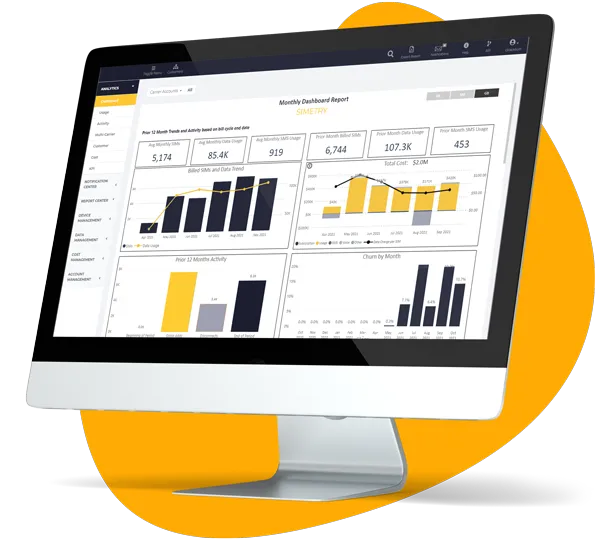
Consistent monitoring, usage analytics, and policy across every connection, in the SIMETRY IoT Platform.
The Result:
A consistent security boundary… from ten devices to a global deployment.
More than security: control and cost management
A Private APN works the same way for every device on it. There is no per-device configuration to maintain and no tunnel to keep alive.
Secure your network
- Keep device traffic hidden from the public internet and out of reach of malicious actors
- Automate threat detection and prevention with a cloud-based prevention engine
- Block unapproved sites and applications through security filtering
Analyze your data usage
- See exactly how data is used across your fleet, by device and by carrier
- Set usage alerts by hour, day, week, or month
- Monitor every device from a single portal
Control data and cost
- Filter to approved sites and content to stop unbudgeted consumption
- Throttle or cap bandwidth by device, group, or rule
- Enforce mobile use policies automatically
Let's design the right private path
Every Private APN is built around your devices, applications, and security requirements. Here’s what that looks like.
Device profile → Traffic requirements → Network handoff → Deployment plan
Device profile
What’s deployed, which carriers cover your sites, how many SIMs today and at scale
Traffic requirements
Which destinations devices must reach, expected volume, latency and uptime needs
Network handoff
How the APN terminates into your environment: IPsec, private circuit, or cloud interconnect
Deployment plan
Provisioning, validation, cutover, and ongoing support
Most deployments move from scoping to live devices in a matter of days, not months. No minimum SIM count.
Built for connected operations
Private APNs fit deployments where secure, reliable, controlled access matters more than open internet access.
Video surveillance
IdO industriel
remote monitoring, controls, PLCs, and connected equipment
Fleet & telematics
vehicles, cameras, gateways, and mobile operations
Soins de santé
connected medical assets and distributed clinical operations
Business continuity
secure cellular backup for critical locations → Failover packages
Utilities & energy
metering, SCADA, and remote site infrastructure
Private APN FAQs
What is a Private APN?
A Private APN is a private access point into a mobile carrier’s network, reserved for your SIMs only. Devices attach to an isolated IP address space that routes exclusively to destinations you approve, instead of the carrier’s shared public internet gateway. Device IPs are not visible on the public internet, which removes them as a target for scanning and attack.
What is Fusion Private APN?
Fusion Private APN is SIMETRY’s multi-carrier private APN. It combines multiple carrier networks into a single private network with one IP address scheme, one routing policy, and one handoff into your infrastructure. A standard private APN is built per carrier, so multi-carrier fleets normally require parallel private networks. Fusion consolidates them into one.
Can a Private APN work across multiple carriers?
Yes, with Fusion Private APN. Standard private APNs are carrier-specific, meaning each carrier needs its own APN, address space, and network handoff. Fusion unifies them, so you can choose the best carrier at each site, build in carrier redundancy, and keep every device on the same private network with the same security policy.
How long does it take to set up a Private APN?
Setup depends on how traffic hands off into your environment, but most deployments are scoped, configured, and live within days. SIMETRY handles APN configuration, SIM provisioning, and the network handoff, then validates connectivity with your team before rollout.
Do I need a static IP with a Private APN?
Not usually. Devices in a Private APN receive private addresses that your systems can reach directly, which covers most of what teams use public static IPs for — without the public exposure. Static IPs are still available when a specific application requires one. See Static IPs for IoT.
Can devices in a Private APN still reach the internet?
Only if you allow it. Routing is defined by policy: you can deny general internet access entirely, permit specific destinations such as an update or NTP server, or route internet-bound traffic through your own network and security stack.
Is there a minimum number of devices?
No. SIMETRY builds Private APNs for deployments of every size, from a handful of SIMs to fleets in the tens of thousands. Pricing is based on your usage and configuration rather than a fixed package.
What happens if a device is lost or stolen?
A SIM can be suspended or removed from the Private APN immediately, cutting the device off from your network. Because devices have no independent public route, a removed SIM has no path back in — unlike a device holding cached VPN credentials.
Which carriers does SIMETRY support?
SIMETRY is carrier-agnostic and works with major U.S. networks, with global reach through Wireless Logic’s relationships spanning 165+ countries and 50+ mobile network operators. Fusion Private APN lets you use more than one of them on a single private network.
How is a Private APN different from IPsec?
A Private APN isolates devices inside the carrier network; IPsec encrypts traffic traveling across the public internet through a tunnel built for each device. The two can be combined, but a Private APN removes per-device tunnel setup, maintenance, and data overhead. Full comparison →
Contacter les ventes
Un gestionnaire de compte spécialisé vous contactera.
Temps de réalisation estimé : moins d'une minute.
- S'entretenir avec le service des ventes
- 1-833-746-3879
- Du lundi au vendredi, de 8 h à 17 h, heure d'Europe centrale
- Élaborer un plan IdO
- Obtenir un devis de matériel
- Embarquez vos appareils
Simple IoGestion des T
Améliorez radicalement la gestion des appareils IoT et des données cellulaires grâce à notre plateforme unifiée de gestion des SIM.
Suivez l'utilisation des données des capteurs, des routeurs et de tout ce qui est connecté à votre réseau IoT cellulaire.
Il vous suffit de vous connecter à votre tableau de bord pour obtenir des mises à jour en temps réel sur l'utilisation des données de votre flotte SIM, les limites, les dépenses et plus encore.